
Conversion attribution is one of the most important aspects of any digital marketing strategy. Choosing the right attribution model is essential if you want to analyze campaign performance properly.
Contents
What is an attribution model?
An attribution model is a set of rules used to assign value to each of the channels a user interacts with before completing a conversion.
Attribution models allow us to analyze the customer journey, in other words, the path a user follows from their first visit to a website to the moment they convert. In an ecommerce business, for example, that conversion could be a purchase. Looking at the journey makes it possible to understand which marketing channels influenced that sale before it happened.
What are attribution models used for?
We operate in a multichannel environment, where businesses communicate with customers and potential customers through a range of channels such as search engines, social media, and email, among others.
A suitable attribution model helps us understand which channels bring in users and which ones actually contribute most to conversions. That makes it easier to adjust the marketing strategy and focus resources on the channels delivering the strongest results.
Types of attribution models
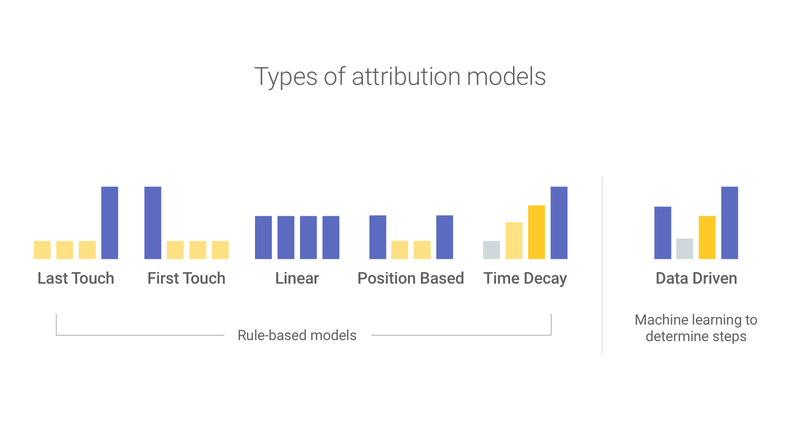
There are many different attribution models, and each one assigns conversion credit differently across the touchpoints in the user journey. There is no single correct model for every business. The right choice depends on the company, its objectives, its marketing strategy, and the type of product or service it offers.
Last click
The last click attribution model gives 100% of the conversion credit to the final interaction before the conversion takes place.
For example, if a user first visits the site through a Facebook ad and then returns a few days later through an organic search result before converting, the conversion would be assigned entirely to Organic Search, ignoring Facebook Ads’ contribution.
In GA4, last click is still available as a reporting attribution model, although Google Analytics now uses data-driven attribution by default.
Last non-direct click
The last non-direct click model assigns conversion credit in a similar way to last click, but it ignores direct visits that happen before the conversion.
A visit is considered direct when a user reaches the website by typing the URL manually or using a saved bookmark or link. Since that user already knows the brand, excluding direct traffic can sometimes provide a clearer view of the channel that actually drove the conversion path forward.
This logic is still relevant today because GA4 attribution models also exclude direct traffic from receiving credit unless the path consists entirely of direct visits.
Google Ads last click
This model is especially useful for businesses that focus heavily on Google Ads.
It assigns 100% of the conversion credit to the last Google Ads interaction before the user converts. This makes it easier to evaluate the role of Google Ads specifically within the overall conversion process. In GA4, the closest equivalent is the Google paid channels last click model.
First click
The first click attribution model gives 100% of the conversion credit to the first interaction between the user and the business.
For example, if a user first lands on the website through an organic search result and later returns through an Instagram ad before converting, the full value of the conversion would be assigned to Organic Search, regardless of what happened afterwards.
This model is still useful conceptually, especially when the goal is to understand which channels are best at generating initial awareness, although it is no longer available as a standard GA4 reporting attribution model.
Linear attribution
The linear attribution model distributes the total value of the conversion equally across all the channels the user interacted with before converting.
If a user first arrives through a Facebook ad, then through a Google ad, and finally converts after clicking an email, all three channels would receive the same share of the conversion value.
As with first click, this model is useful for understanding the full journey, although it is no longer part of GA4’s standard reporting attribution options.
Time decay
The time decay model also distributes conversion credit across multiple touchpoints, but it gives more weight to interactions that happen closer to the conversion.
That means earlier interactions receive less credit, while later interactions are treated as more influential in the final conversion.
This is another model that remains useful from an analytical point of view, even though it is no longer available in GA4’s standard attribution settings.
Position-based attribution
Position-based attribution, also known as U-shaped attribution, gives more credit to the first and last interactions, while distributing the remaining value across the touchpoints in between.
For example, if a user first visits through Twitter, later clicks a Google Ads campaign, and finally returns through Facebook before converting, Twitter and Facebook would receive most of the credit, while Google Ads would receive a smaller share.
Like the previous models, this one helps illustrate different ways of understanding the customer journey, but it is no longer available in standard GA4 reporting attribution.
Attribution in Google Analytics
Although attribution models are still a key part of analysis, the way they are handled in Google Analytics has changed since Universal Analytics. In GA4, attribution settings are configured at property level, and the reporting attribution model can be changed depending on how you want key events and revenue to be distributed across touchpoints.
GA4 currently offers a more streamlined setup. For paid and organic channels, you can use data-driven attribution or last click. For Google paid channels, you can use last click. Data-driven attribution is the default model in GA4 and distributes credit based on the property’s own data.
That means the key question is no longer just which predefined model to choose, but which attribution approach best fits the business and how results should be interpreted based on that model. In practice, understanding the customer journey is still what matters most. The attribution model is simply the framework used to assign value to each touchpoint within that journey.
In short, attribution models help us understand how users interact with a company’s marketing channels before converting. Choosing the right approach makes it easier to identify which channels are contributing most to results and to make better decisions about where to focus marketing efforts.
